Most "best portable water filter" rankings are written for affiliate revenue, not for the question you actually asked. The honest answer depends on what you're filtering against and where. We've broken this down by use case and listed the spec that matters most for each — so you can match a category to your actual situation, regardless of which specific brand you end up choosing.
For the full background on filter types, technologies, and certifications, see our Portable Water Filter — Complete Buyer's Guide.
Quick verdict — by category
| Use case | Best filter type | Critical spec |
|---|---|---|
| Daily urban (gym, office, commute) | Bottle-top 0.2-micron ultrafiltration | 0.2 μm pore size, NSF P477 |
| Domestic travel (US/EU hotels) | Bottle-top 0.2 μm | Compact, fits standard PET |
| International travel (developed) | Bottle-top 0.2 μm + carbon | Adds taste improvement |
| International travel (developing region) | 0.1 μm filter + chemical/UV backup | Virus protection essential |
| Day hiking / casual outdoor | Squeeze filter (Sawyer-style) | Lightweight, fast flow |
| Backcountry / multi-day | Pump or gravity filter | 0.1 μm, high capacity |
| Emergency / disaster prep | Multi-stage stack | Filter + chemical + UV redundancy |
Best for daily urban use
The category: bottle-top microfiltration. The use case is broadly safe water (US/EU tap, domestic bottled water) where the actual threat is microplastics. You don't need a backpacker pump for this — and a backpacker pump for daily commute use is overkill.
What to look for:
- A published micron pore size — around 1–2 microns is enough to capture the microplastic fraction found in tap and bottled water
- A mechanical sieving membrane, not carbon alone (carbon improves taste but does not block particles)
- 1881 DIN universal bottle thread compatibility (so it works with any standard PET bottle)
- Replacement filter availability — and a transparent price-per-liter calculation
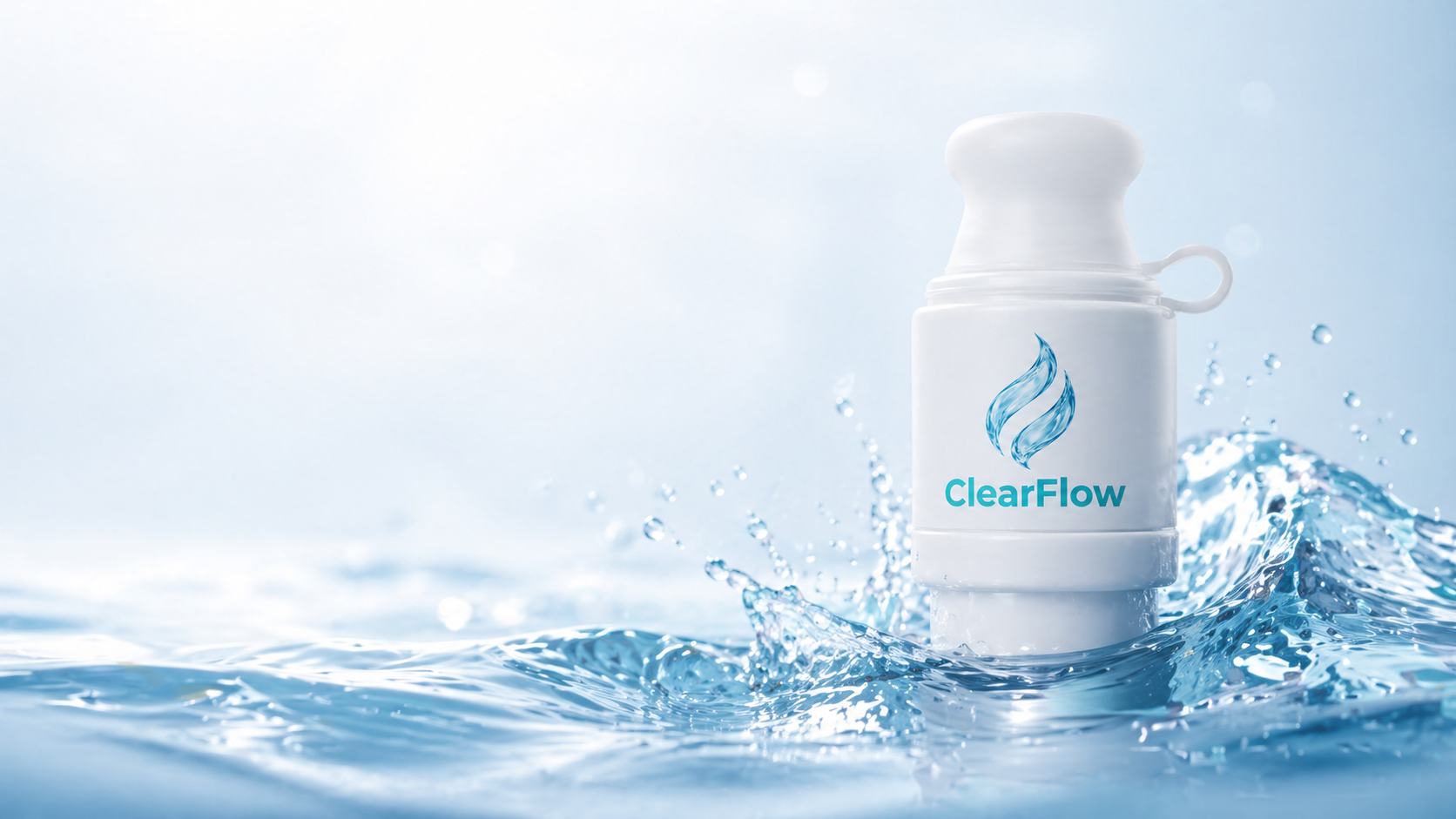
Our pick: ClearFlow — built specifically for this use case. 2-micron pleated microfiltration membrane, snaps onto any standard PET bottle, reduces 99% of microplastics 2 microns and larger. ~$0.04 per liter over filter lifespan vs. $1.50+ for bottled water. Designed in the USA, engineered with German precision.
Best for international travel
The category: 0.1 micron or finer filtration with chemical or UV backup. International travel — particularly to South Asia, parts of Africa, parts of Latin America — adds viruses and pathogen loads to the threat list. Standard 0.2-micron filters do not reliably remove viruses.
What to look for:
- NSF/ANSI P231 (microbiological purifier standard) — covers bacteria, viruses, cysts
- 0.1 μm or finer filter pore size, or hollow-fiber + activated carbon stack
- Chemical backup (chlorine dioxide tablets) for water of unknown source
Our pick: A combination — a bottle-top microfiltration filter (e.g., ClearFlow) for daily use plus chemical tablets (Aquatabs) or a UV pen (SteriPEN) as virus backup. The combined cost is still under $100 and covers significantly more ground than any single product.
Best for hiking and casual outdoor
The category: squeeze filters. The use case is filling from a stream or lake, drinking, and moving on. Weight matters; setup time matters.
What to look for: 0.1–0.2 μm hollow-fiber, lightweight pouch, integrated bite valve. Sawyer Squeeze and Katadyn BeFree dominate this category for good reason — durable, fast, light.
For shorter trips with municipal-water topup capability, a bottle-top microfiltration filter is also a perfectly reasonable answer that doubles as your daily-use filter — one piece of gear, two purposes.
Best for backcountry and multi-day expeditions
The category: pump or gravity systems with 0.1 μm or finer membranes. The use case is sustained group water needs, often from sediment-rich sources, sometimes in cold weather where squeeze filters slow down.
What to look for: high-capacity (5,000+ liters), pump or gravity flow rated for the group size, virus-rated where the water source warrants. Brands historically dominant: Katadyn (Pocket, Hiker), MSR (Guardian, MiniWorks), Platypus GravityWorks.
This is the category where price-vs-performance is steep. Sub-$50 pump filters compromise on virus protection or longevity. Above $200, you're getting expedition-grade.
Best for emergency preparedness
The category: a stack rather than a single product. Emergency scenarios involve unknown contamination — chemical spills, sewage backflow, biological hazards, prolonged power outages affecting municipal treatment.
What to assemble:
- One 0.1-micron mechanical filter (squeeze or pump)
- One activated-carbon stage (in-line or separate)
- Chemical backup (chlorine dioxide tablets or unscented household bleach)
- One UV option (SteriPEN, with spare batteries)
- One day-to-day bottle-top microfiltration filter you actually use, so the gear is field-tested before you need it
The last point is non-trivial. Emergency gear that has never been used has a higher failure rate than gear that gets routine use. A daily-use bottle-top microfiltration filter doubles as your "I know how this works" insurance.
What to ignore in marketing copy
- "Removes 99.99% of impurities" — meaningless without specifying which impurities and which test method.
- "Hospital-grade" — has no regulated meaning. "Medical-grade hollow-fiber" tied to a USP <1229.4> sterile-filtration spec is a meaningful claim.
- "Removes microplastics" without a stated pore size. If the pore size isn't published, treat the claim skeptically.
- "Tested by [lab]" without an NSF/ANSI standard number. Self-paid testing is not the same as independent certification.
Honest disclosure
This page is published by ClearFlow. We make a 2-micron portable bottle-top filter and we recommend it specifically for daily urban use. We do not have an affiliate relationship with the other brands mentioned (Sawyer, Katadyn, MSR, Platypus, SteriPEN). Their inclusion is on merit for their respective categories.
For daily urban use, this is what we built.
2-micron pleated microfiltration in a snap-on cap that fits any standard PET bottle.
- 99% microplastic reduction (particles 2 microns and larger)
- Universal 1881 DIN thread compatibility
- Designed in the USA, engineered with German precision
FAQ
What is the best portable water filter overall?
There is no single "best" — the best filter is the one matched to your use case. For daily urban use, a bottle-top 0.2-micron ultrafiltration filter wins. For wilderness, a 0.1-micron pump or gravity system wins.
Are LifeStraw and Sawyer the same kind of filter?
Both are hollow-fiber ultrafiltration filters at 0.1–0.2 μm. LifeStraw is positioned more for emergency / single-user direct-drink. Sawyer Squeeze is more flexible for group use and refilling containers.
Is there a "best for everything" filter?
The closest answer is a 0.1-micron filter with activated carbon and chemical-tablet backup. But carrying that on a commute is overkill — and using a backpacker pump at the office is impractical. Match the tool to the task.
Related reading
Pillar Guide
Portable Water Filter — Complete Buyer's Guide
Filter types, technologies, certifications, and the spec checklist.
Cluster
Travel water filter — by region and risk
Country-specific guidance, what to pack, and what airlines allow.
References
- NSF/ANSI 42, 53, P231, P477 — Drinking Water Treatment Units standards.
- Mulchandani, A. et al. (2022). Membrane filtration for the removal of microplastics from water. Environmental Pollution.
- WHO (2019). Microplastics in drinking-water. World Health Organization.
- U.S. Environmental Protection Agency — Microplastics Research.