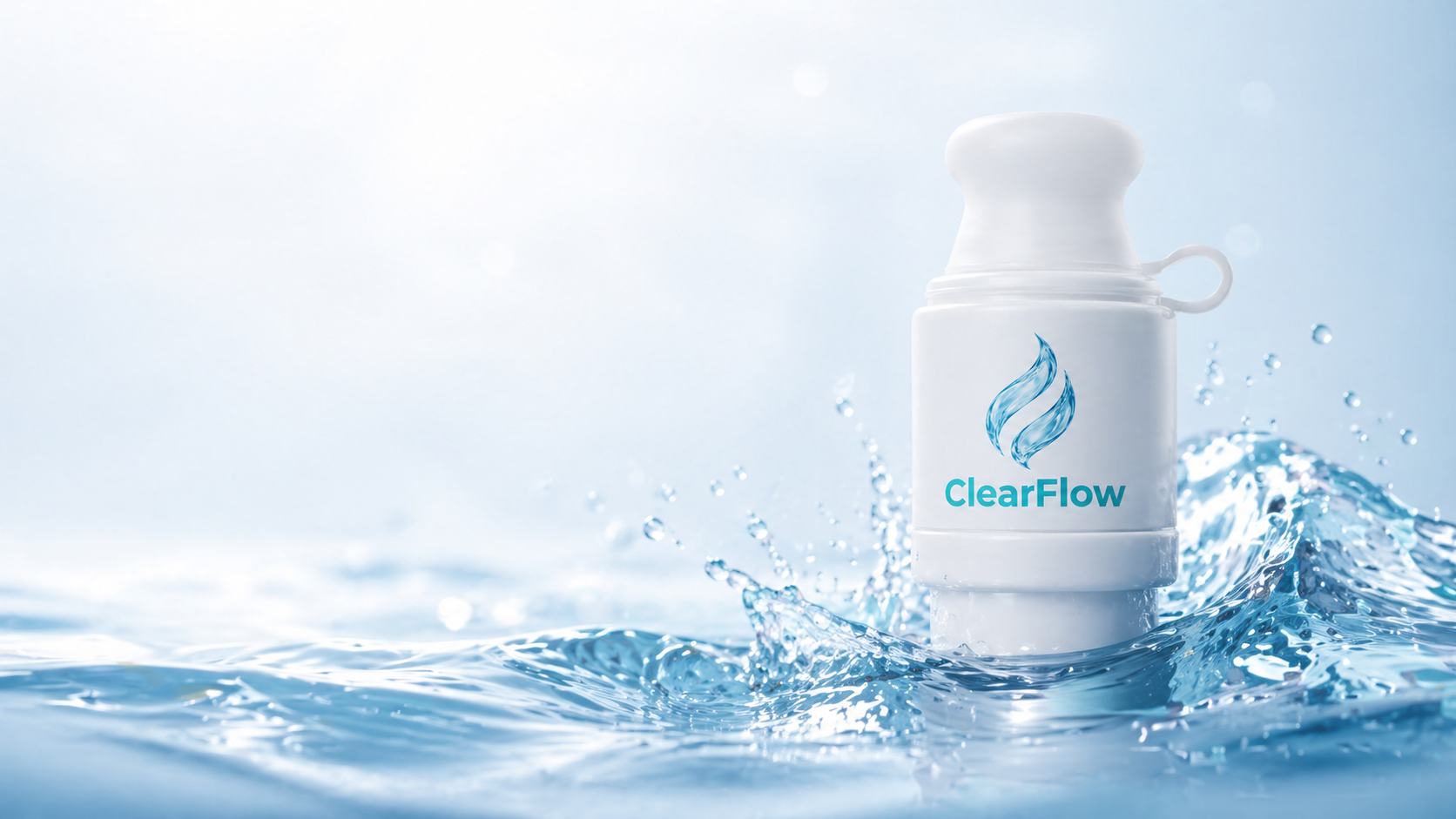
TL;DR: Every plastic bottle of water contains microplastics. A cap-style microplastic filter screws onto the standard bottle thread (DIN 1881) and filters them out as you drink. No new bottle, no pitcher, no plumbing.
Pillar guide: for the broader picture on contamination sources, health research, and regulation, read Microplastics in Drinking Water — The Complete Guide.
Short version: A cap-style microplastic filter is a small screw-on filter that replaces the original cap of a standard plastic water bottle. It filters microplastics out of the water as you drink. It is not a faucet filter, not a pitcher, and not a home treatment system — it is the simplest way to clean up the bottled water you already buy.
Why a Microplastic Filter for Your Water Bottle Matters
A 2024 study from Columbia University and Rutgers, published in the Proceedings of the National Academy of Sciences, found roughly 240,000 plastic particles per liter in the average bottle of bottled water — about 90% of them nanoplastics. That is more than ten times higher than earlier estimates. You can read the original study on PNAS.
The problem is not the bottle you buy once a week. The problem is the bottle you buy every day at the gas station, the airport, the gym, the office. Most American adults drink several plastic bottles per week without thinking about it. That is exactly the moment a microplastic filter for a water bottle becomes useful: you do not have to change your habit, you change your cap.
What microplastics actually are
Microplastics are plastic particles smaller than 5 millimeters. Nanoplastics are even smaller, below 1 micrometer. Both come from the bottle itself, the cap, and the bottling process. Heat, sunlight, and time accelerate shedding. A bottle that sat in a hot truck for a week sheds more than one straight off the production line.
What a cap filter does — and what it does not
Be clear about scope. A cap-style filter is a single-purpose tool. It removes microplastics. That is the job.
- It filters: microplastic and nanoplastic particles down to the filter's rated pore size.
- It does not filter: chlorine, lead, fluoride, PFAS, bacteria, or hard-water minerals. For those, you need a different category of product entirely.
That clarity matters. A lot of marketing in the water space promises everything and delivers little. A cap filter is honest hardware: one job, done well, on every bottle.
How Cap-Style Bottle Filters Work
The mechanism is mechanical, not chemical. Water passes through a fine filtration medium as you drink. Particles above the rated size are physically blocked. The water that reaches your mouth has fewer microplastics than the water still sitting in the bottle.
The flow path, step by step
- You unscrew the original cap from your plastic bottle.
- You screw the cap-style filter onto the same thread.
- You tip the bottle and drink, or squeeze.
- Water leaves the bottle, passes through the filter medium inside the cap, and exits through the spout.
- Microplastic particles stay trapped in the filter. You drink the cleaner water.
There is no electricity, no battery, no app. The only moving part is you tilting the bottle.
Why it fits: the DIN 1881 standard
This is the quiet engineering detail that makes the whole product category possible. Almost every plastic water bottle sold in the United States — Dasani, Aquafina, Poland Spring, Fiji, Smartwater, generic store brands — uses a standardized neck thread called PCO 1881, the global beverage industry's thread standard, often referenced as DIN 1881. The thread is the same diameter, the same pitch, and the same finish across virtually every PET bottle on the shelf.
That means one cap filter fits the bottles you already buy. You do not need a special bottle. You do not need to buy water from a particular brand. You bring the cap, the world brings the bottle.
Pore size and what it means in practice
Filtration is rated by pore size in micrometers (μm). Smaller pore size catches smaller particles but slows water flow. Cap-style microplastic filters generally operate in a range chosen to balance flow with meaningful particle capture — tight enough to remove the visible and microscopic plastic fragments measured in the PNAS study, loose enough that you can actually drink without squeezing for a minute. For a deeper technical dive, see 0.2-Micron Filtration Explained.
Cap Filter vs. Other Filtration Options
This is where most buyers get confused. The water-filtration market is crowded, and the products are not interchangeable. Here is how a portable microplastic filter compares to the alternatives most people consider.
| Option | What it filters | Where it lives | Cost to start | Works on bottled water? |
|---|---|---|---|---|
| Cap-style microplastic filter | Microplastics | On any standard plastic bottle | Low | Yes — that is the entire point |
| Pitcher filter (e.g. activated carbon) | Chlorine, taste, some metals | Kitchen counter | Low | No — you fill it from the tap |
| Faucet filter | Chlorine, sediment, some lead | Bolted to your sink | Medium | No |
| Reverse osmosis system | Almost everything, including microplastics | Under the sink, plumbed in | High | No |
| Filtered water bottle (proprietary) | Varies by brand | Their bottle only | Medium | No — you must use their bottle |
| Boiling water | Bacteria, not plastics | Stove | Free | No |
Notice the pattern. Every option except the cap filter requires you to either change your habit (use a pitcher), change your bottle (proprietary system), or change your home (plumbing). The cap-style filter is the only category that meets you where you already are: at a gas station, holding a bottle of water you just bought.
When a cap filter is the right tool
- You drink bottled water regularly — at work, traveling, at the gym, in the car.
- You are specifically concerned about microplastics.
- Your tap water is fine, but you are not always at the tap.
- You want a one-time hardware purchase, not a subscription.
When it is not the right tool
- You have a chlorine taste problem at home — that is a pitcher or faucet filter.
- You have a lead service line — that is a certified lead-removal device, often under-sink.
- You are trying to make unsafe water safe to drink — that is a survival-grade purifier with a microbiological claim, not a microplastic filter.
What to Look For in a Portable Microplastic Filter
Not every screw-on filter is the same. A few criteria separate a useful product from a gimmick.
1. Thread compatibility
The filter must fit the standard PCO 1881 / DIN 1881 thread used by mainstream U.S. bottled water brands. If a product requires a special bottle, it is not really a cap filter — it is a proprietary bottle system.
2. Honest filtration claims
The filter should state what it removes and, equally important, what it does not. A product that claims to remove microplastics, heavy metals, chlorine, fluoride, and bacteria from a single small cap is over-promising. Real engineering trade-offs exist between pore size, flow rate, and contact time. Single-purpose hardware is the honest answer.
3. Flow rate you can actually drink
If you have to squeeze a bottle for thirty seconds to get a sip, you will stop using it. Good cap filters balance pore size and flow so the experience feels close to drinking from a normal cap.
4. Materials in contact with water
The cap and filter housing should be made of food-grade, BPA-free materials. Ironic as it sounds, you do not want a microplastic filter that itself sheds plastic.
5. Filter life and replacement
Every filter has a lifespan, measured in liters or bottles. Look for a clear figure (for example, "good for 100 bottles") and an obvious replacement plan. Avoid products with vague or open-ended life claims.
6. No subscription lock-in
You should be able to buy refills as needed. A subscription is fine if you want one. A filter that only works on a subscription is a flag.
Real-World Use Cases
Travel
Hotel mini-fridges run on bottled water. Airports sell bottled water past security. International trips often mean local bottled brands you have never seen before. A cap filter goes in your carry-on and works on all of it.
The car and the commute
The single worst place to store water is a hot car. Heat dramatically increases plastic shedding. If your bottle of water has been baking in the cup holder, a cap filter is doing its most useful work right there.
The office
Many U.S. offices stock branded bottled water in fridges and break rooms. Employees grab two or three a day without thinking. One cap, one workday.
The gym
Single-use bottles of water are part of the routine. The same cap clicks onto whatever brand the gym vending machine sells.
Maintenance: Getting It Right
A microplastic filter only works if you actually maintain it. Three rules cover most of it.
- Track usage. Either count bottles or set a calendar reminder. When the rated life is up, swap the cartridge.
- Rinse after use. A quick rinse of the cap with clean water keeps the spout area clean and prevents buildup.
- Store dry. When you are not using it for a few days, let it dry rather than leaving it sealed wet. That is general hygiene, not microplastic-specific.
None of this is complicated. It is closer to taking care of a reusable water bottle than to maintaining a home filtration system.
Cost Math: Cap Filter vs. Buying "Premium" Water
A common reaction to microplastic news is to switch to glass-bottled or premium-brand water. The math does not flatter that decision.
| Approach | Typical monthly cost (moderate drinker) | Microplastics removed? |
|---|---|---|
| Switching to glass-bottled water | $60–$120 | Lower starting load, but you change your whole habit |
| Switching to a premium plastic brand | $40–$80 | Studies show similar microplastic counts across brands |
| Cap-style microplastic filter + refills | Hardware once, refills are a few dollars | Yes, on whatever bottle you buy |
The cap filter is the only option that lowers microplastic exposure without requiring you to change brands, change retailers, or change behavior.
Common Misconceptions
"If I just use a reusable bottle, I am fine."
Reusable bottles are great for a lot of reasons, but they do not address the moments you actually buy a single-use bottle — flights, road trips, events, days you forgot the reusable. Those are exactly the moments microplastic exposure is highest.
"Bottled water is regulated, so it must be clean."
The U.S. FDA regulates bottled water for chemical and microbial safety. Microplastics, however, are not part of the standard testing regime in the U.S. Regulation has not caught up with the science yet.
"A small cap cannot really filter that much."
Mechanical filtration scales with surface area and flow rate, not with the size of the housing. A well-designed cap filter has enough filter media to handle the volume of water in a bottle without breaking flow.
"Boiling will solve it."
Boiling kills microbes. It does not remove plastic particles. In some cases, heating plastic increases shedding.
One cap. One job. Every bottle.
ClearFlow is a cap-style microplastic filter built for the standard plastic bottles sold across the U.S. Unscrew the original cap, screw on ClearFlow, drink. Same bottle, cleaner water.
- Fits PCO 1881 / DIN 1881 standard bottle thread
- Single-purpose: removes microplastic particles
- No subscription, no proprietary bottle, no power required
FAQ
Does a cap-style microplastic filter fit every plastic water bottle?
It fits any bottle that uses the standard PCO 1881 / DIN 1881 neck thread, which is the industry standard for almost every plastic water bottle sold in the U.S., including Dasani, Aquafina, Poland Spring, Fiji, Smartwater, and most store brands. If a bottle has the standard ribbed neck and twist-off cap, the filter fits.
Does a microplastic filter for a water bottle remove chlorine or lead?
No. Cap-style filters are single-purpose and remove microplastic particles only. They are not designed to remove chlorine, lead, fluoride, PFAS, or bacteria. For those concerns at home, a different category of product such as a faucet filter, pitcher, or under-sink system is the right tool.
How long does a cap filter last before I need to replace it?
Filter life is measured in liters or bottles. A typical cap-style microplastic filter is rated for around 100 bottles before the cartridge should be swapped. The exact figure should be stated clearly on the product packaging, and replacement cartridges should be available without a subscription.
Is it safe to drink bottled water without a microplastic filter?
Bottled water sold in the U.S. is regulated by the FDA for chemical and microbial safety, so it is generally safe in the conventional sense. However, recent studies show typical bottled water contains hundreds of thousands of microplastic and nanoplastic particles per liter, which standard regulations do not currently address.
How is a cap filter different from a filtered water bottle like LifeStraw or Brita?
Filtered water bottles are proprietary systems — you must use their bottle, and they are usually optimized for tap water or wilderness use. A cap-style filter screws onto the standard plastic bottles you already buy, so you keep your habit and your bottle of choice. It also focuses specifically on microplastics rather than mixing claims.
Will a cap filter slow down how fast I can drink?
A well-designed cap filter is engineered to balance pore size with flow rate, so the drinking experience feels close to a normal sport cap. You will notice slightly more resistance than an unfiltered bottle, but you should not have to squeeze hard or wait for water to come through.
Related reading
Pillar Guide
Microplastics in drinking water — the complete guide
Sources, health risks, regulation, and the full filtration landscape.
Technology
0.2-Micron filtration explained
The technical sweet spot between what your filter blocks and what gets through.
Sources
- Qian, N. et al. (2024). Rapid single-particle chemical imaging of nanoplastics by SRS microscopy. Proceedings of the National Academy of Sciences.
- U.S. Food and Drug Administration. Bottled Water Everywhere: Keeping it Safe.
- ISO 9058 / PCO 1881 — Standard bottle neck finish for non-refillable PET bottles (beverage industry standard, often referenced as DIN 1881).