Kurz: "On-the-go water filtration" is not one product category — it's five. Filter bottles, screw-on cap filters, straws, pumps and UV pens all solve different problems. A backpacker in Patagonia needs something a commuter in Chicago does not. This guide compares every form factor honestly, shows what each one actually removes, and helps you match the tool to your water.
What "On-the-Go Water Filtration" Actually Means
The term covers any filter you can carry in a bag, pocket or backpack and use without plumbing, electricity or a countertop. That definition rules out pitcher filters, faucet attachments and reverse-osmosis systems. It includes anything from a $15 filtered straw to a $90 filter bottle — and a newer category most shoppers haven't heard of yet: the screw-on cap filter that turns a regular plastic bottle into a filtered one.
The portable filter market in the US has grown sharply since 2020, driven by three things: tap-water trust issues after Flint and Jackson, the explosion of microplastics research, and a cultural shift toward reusable hydration. But the marketing language has gotten loose. A bottle that filters chlorine taste is not the same as a bottle that filters bacteria. A filter rated for "99.9% reduction" of one contaminant tells you nothing about the other 200 contaminants in your water. That's the gap this guide closes.
The Five Form Factors at a Glance
Before diving into each, here's how the categories compare on the dimensions buyers actually care about: portability, what they filter, how often you replace the cartridge, and roughly what they cost.
| Form Factor | Typical Use | Filters | Cartridge Life | Starter Cost |
|---|---|---|---|---|
| Filter bottle | Daily carry, gym, office | Chlorine, taste, some heavy metals; better models filter bacteria | 2-3 months | $30-90 |
| Screw-on cap filter | Bottled water on the go | Microplastics | 1-2 months / ~100 L | $15-30 |
| Straw filter | Hiking, emergency | Bacteria, parasites, sediment | 1,000-4,000 L | $15-25 |
| Pump / gravity filter | Backcountry, travel abroad | Bacteria, parasites, viruses (some) | Years | $70-300 |
| UV pen | Treated municipal water abroad | Microorganisms only | Battery-dependent | $80-130 |
Notice that no single product covers everything. That's not a flaw — it's physics. Filtration is always a trade-off between pore size, flow rate, weight and price. The honest question isn't "which is best?" but "which is right for the water in front of me today?"
Filter Bottles: The Default Choice for US Cities
A filter bottle is a reusable bottle with a built-in cartridge in the lid or straw. You fill it from a tap, fountain or sink and drink through the filter. Brands like Brita, LifeStraw Go, Epic Nalgene and Larq dominate this segment. Most use activated carbon for taste and odor; some add ion-exchange media for lead, and a few pair carbon with hollow-fiber membranes for bacteria.
The strengths are obvious: one purchase, no extra steps, dishwasher-safe shells in many cases. The weaknesses are the things buyers discover later. Activated carbon does not remove most dissolved minerals, nitrates, fluoride, PFAS at low ppt levels, or microplastics smaller than the carbon's effective pore size. Cartridges also lose performance long before they look exhausted — most manufacturers suggest replacement at 40 gallons or roughly 60 days, whichever comes first.
Filter bottles are the right answer when your water source is treated US municipal tap water and your concern is taste, chlorine and lead. They are the wrong answer for backcountry streams, foreign tap water of unknown microbial status, or the specific problem of microplastics already inside sealed bottled water. We compare the trade-offs in detail in our Filter Bottles vs Screw-On Cap Filters breakdown.
Screw-On Cap Filters: The Newest Category
A screw-on cap filter is a small filtration cap that threads onto the standard PET bottle neck (the DIN 1881 thread used on virtually every disposable plastic water bottle sold in the US). Instead of pouring water out of a Dasani or Aquafina bottle, you screw on the cap and drink through it. The bottle stays the same; the cap does the filtering.
This category exists because of a specific, well-documented problem: bottled water already contains microplastics. A 2024 study using stimulated Raman scattering microscopy found an average of 240,000 plastic particles per liter in three popular US brands — about 90% of them in the nanoplastic range. Filter bottles don't help here because the problem isn't the source water; it's the bottle itself shedding particles. Cap filters target that exact failure mode by filtering the water on its way out, after it has already absorbed plastic from the container.
Cap filters do one thing: remove microplastics from bottled water. They don't filter chlorine, heavy metals or bacteria, and reputable brands (including Clear Flow) say so plainly. The category is small, new, and dominated by 0.2-micron ultrafiltration membranes. We unpack the mechanics in Bottle Cap Water Filters: How They Work and the membrane science in 0.2-Micron Filtration Explained: What It Removes and Why It Matters.
Straw Filters: Backcountry and Emergency Tool
A straw filter is a hollow tube with a hollow-fiber membrane inside. You drink directly from a stream, lake or sketchy tap. The original LifeStraw, the Sawyer Mini and the Aquamira Frontier are the dominant products. Pore sizes range from 0.1 to 0.2 microns, which is small enough to physically block bacteria like E. coli and parasites like Giardia and Cryptosporidium.
What straws don't filter: viruses (most are too small at 20-200 nanometers), heavy metals, dissolved chemicals, salt or chlorine taste. They're built for a single use case — converting questionable freshwater into drinkable water in the field. For US day hikes and emergency kits they're nearly perfect. For international travel where waterborne viruses like hepatitis A and rotavirus are a real concern, they're insufficient on their own.
The economics are also unusual: a $20 straw can filter 1,000 to 4,000 liters before clogging. That's three or four cents per liter — cheaper than any other portable option if you actually use it. The catch is that most buyers don't. They buy one for a hurricane kit and forget about it for years.
Pump and Gravity Filters: Serious Backcountry
Pump filters (Katadyn Hiker, MSR Guardian) and gravity filters (Platypus GravityWorks, Sawyer Squeeze setups) are what backpackers and humanitarian workers actually carry when they need to process liters of water from rivers or wells. They use the same hollow-fiber technology as straws but with a higher flow rate, larger volume and — in premium models — fine enough membranes to remove viruses.
The trade-off is bulk. A Guardian weighs 17 ounces and costs around $390. A GravityWorks 4L weighs 11.5 ounces and costs $130. These are not commute tools. They are the right call for week-long trips, multi-person travel in regions with poor water infrastructure, or any scenario where you need to produce drinking water in volume from an unknown source.
If you're traveling internationally and worried about water, our Travel Water Filter: A Country-by-Country Guide guide breaks down which filter type to bring by destination. The short version: hollow-fiber membranes for Latin America and Southeast Asia, virus-rated filters or chemical backup for parts of Africa and South Asia, and often nothing at all for Western Europe and Japan.
UV Pens and Chemical Treatment
UV pens (SteriPEN) use a UV-C lamp to inactivate microorganisms by scrambling their DNA. They work fast — 90 seconds for a half-liter — and they kill viruses as well as bacteria and parasites. But they only work in clear water and only treat what's in the bottle right then. They don't remove particles, sediment, chemicals, heavy metals or microplastics. They also depend on batteries, which is a real failure mode in the field.
Chemical treatments — chlorine dioxide tablets like Aquatabs or Katadyn Micropur — are even simpler. Drop a tablet in, wait 30 minutes (longer for cold water and Cryptosporidium), drink. They're light, cheap and shelf-stable for years. They share the same limits as UV: pathogens only, no particle removal, plus a slight chemical taste. Both are good complements to a particle filter, not replacements for one.
What Each Type Actually Removes
This is the table most buyers wish they'd seen before spending $80 on the wrong product. "Removes" here means a meaningful, manufacturer-verified reduction — not a marketing footnote.
| Contaminant | Filter Bottle (carbon) | Cap Filter (UF) | Straw (UF) | Pump (UF/RO) | UV Pen |
|---|---|---|---|---|---|
| Chlorine, taste, odor | Yes | No | No | Carbon stage only | No |
| Lead, some heavy metals | Some models | No | No | Specialty models | No |
| Bacteria (E. coli, Salmonella) | Some models | Yes | Yes | Yes | Yes |
| Parasites (Giardia, Crypto) | Some models | Yes | Yes | Yes | Yes |
| Viruses | No | No | No | Premium only | Yes |
| Microplastics > 0.2 µm | Varies widely | Yes | Yes | Yes | No |
| PFAS, nitrates, fluoride | Limited | No | No | RO only | No |
Two patterns jump out. First, no portable category handles dissolved chemicals like PFAS or nitrates well — those genuinely require home reverse-osmosis or specialty media. Second, the categories overlap less than marketing suggests. A filter bottle and a cap filter are not substitutes. They solve different problems for different water sources. We go deeper in What Do Water Filters Actually Remove?.
Choosing by Use Case
Most buyers don't have a contaminant list — they have a situation. Here's the matchup, ordered by how common the scenario is in the US market:
- Daily commute, gym, office, US tap water: Filter bottle with carbon plus lead reduction. The chlorine taste is the actual barrier to drinking enough water. Solving that solves the hydration problem.
- You buy bottled water and worry about microplastics: Screw-on cap filter. It targets the exact failure mode — particles shed by the bottle itself. See Microplastics in Bottled Water: What the Studies Actually Show for the data behind this.
- Day hikes, US backcountry, emergency kit: Straw filter or Sawyer Squeeze. Cheap, light, decade-long shelf life.
- International travel, developed country: Often nothing — Western European and Japanese tap water is generally safer than US tap water. A cap filter helps if you're drinking sealed bottled water in plastic.
- International travel, developing country: Hollow-fiber filter plus chemical or UV backup for viruses. A SteriPEN or chlorine dioxide tablets weigh almost nothing and cover the gap.
- Multi-day backpacking with a group: Gravity filter. Faster than pumping, no batteries, scales to several people.
For specific commute setups — locker rooms, glass-bottle offices, school runs — see Water Filter for the Gym, Office & Daily Commute. For an updated head-to-head of products by category, our Best Portable Water Filter 2026: Picks by Use Case round-up tests them on the specs that actually matter.
Cost Over 12 Months
Sticker price hides the real cost. A $40 filter bottle with $15 cartridges replaced every two months is $130 in year one. A $25 cap filter with one $12 replacement is $37. A $20 straw with no cartridges hits $20. Here's a clean comparison assuming average daily use.
| Product Type | Year 1 Total | Year 2 Total | Per Liter |
|---|---|---|---|
| Filter bottle ($40 + cartridges) | ~$130 | ~$90 | $0.18 |
| Cap filter ($25 + 1 replacement) | ~$37 | ~$24 | $0.06 |
| Straw filter ($20) | ~$20 | $0 | $0.01-0.04 |
| Pump filter ($150) | ~$150 | ~$10 | $0.05 |
| UV pen ($100 + batteries) | ~$110 | ~$15 | $0.10 |
The cap filter and the straw look unbeatable on cost-per-liter, but they cover narrow use cases. The filter bottle costs more per liter precisely because it's working harder — running tap water through a multi-stage cartridge several times a day. None of these is "expensive" compared to bottled water, which averages $1.20 per liter at retail. Any portable filter pays back inside two months if it replaces even half your bottled-water purchases.
Common Mistakes Buyers Make
After reading hundreds of buyer reviews, the same five errors show up over and over.
Buying for the wrong contaminant. A filter bottle bought to "remove microplastics" when the buyer actually drinks bottled water. The bottle was never the source — the plastic container was.
Skipping cartridge replacement. Activated carbon is at peak performance for the first half of its rated life and then drops fast. A six-month-old cartridge isn't filtering at half-strength; it's often filtering at near zero, and in some cases releasing accumulated contaminants back into the water.
Confusing taste improvement with filtration. Chlorine is easy to remove and easy to taste. Lead, PFAS and microplastics are tasteless and odorless. Water that "tastes filtered" can still contain everything you bought the filter to remove.
Trusting one number. "99.99% removal" is meaningless without a contaminant name and a particle size. A filter that removes 99.99% of 5-micron particles may remove 0% of 0.5-micron particles.
Treating a portable filter as a home system. No filter bottle, cap or straw is designed to be a household's primary drinking-water solution. Portable filters handle one bottle at a time. They are not a substitute for a properly sized under-sink or whole-house system if your home water has serious issues.
How to Verify a Filter's Claims
The single most useful credential is NSF/ANSI certification. NSF 42 covers aesthetic effects (chlorine, taste). NSF 53 covers health effects (lead, cysts, VOCs). NSF 401 covers "emerging contaminants" including some pharmaceuticals. NSF 244 covers microbiological purification. A filter that lists "NSF 53 lead reduction" has been independently tested. A filter that lists "meets NSF standards" without a number has not.
For microplastics specifically, there is no NSF standard yet — the contaminant category is too new and too heterogeneous. Reputable manufacturers in this space cite particle-size testing (typically using polystyrene microspheres at known concentrations) and publish the test conditions. Anything looser than that is marketing. The Microplastics and Drinking Water: Where the FDA and EPA Stand situation explains why regulators haven't caught up.
You should also check that the manufacturer publishes a flow-rate spec, a service-life spec in liters or gallons, and a clear list of what the product does not remove. The last one is the trust signal. A brand that openly says "this product does not remove chlorine, heavy metals or bacteria" is more credible than one that implies it removes everything.
Where the Category Is Heading
Three trends are reshaping portable filtration through 2026. The first is the splintering of "one filter for everything" into purpose-built tools — exactly the structure this guide reflects. Buyers are getting comfortable owning two or three filters for different scenarios, the way they already own different shoes.
The second is the mainstreaming of microplastic concern. The 2024 NYU study finding microplastics in prostate cancer tumors, the Columbia/Rutgers nanoplastic count in bottled water, and the WHO's ongoing review have moved the topic from fringe to mainstream consumer concern. That's why the cap-filter category exists at all. Five years ago there wasn't a market for it.
The third is regulatory ambiguity. The EPA has not set an enforceable limit for microplastics in drinking water. The FDA does not require microplastic testing for bottled water. That gap is why the burden has shifted to the consumer — and why a product category like screw-on cap filters can launch and grow without any regulatory tailwind. Whether you welcome that or not, it's the current reality. Clear Flow's view is that transparency about what a filter does and doesn't do is the only honest way to operate in a market without standards.
Bottom Line
Pick the filter that matches the water in front of you. For US tap water at the gym or office, a filter bottle is the default. For sealed bottled water, a screw-on cap filter is the only category that addresses the actual problem. For backcountry streams, a hollow-fiber straw or pump. For international travel where viruses are possible, add UV or chemical treatment to whatever filter you carry. No single product wins on every dimension — and any brand that claims one does is the wrong place to start.
One filter, one job — done right.
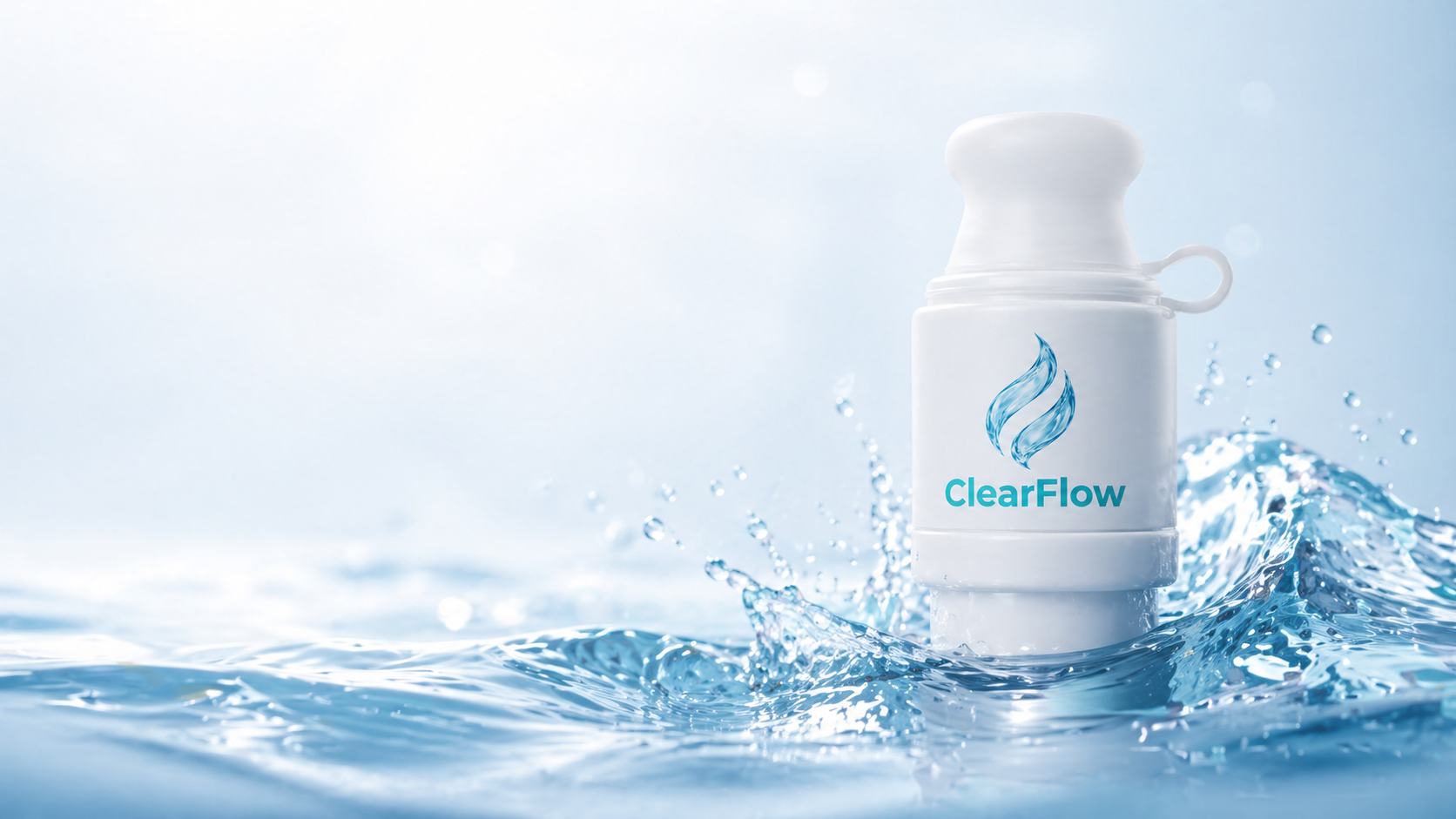
ClearFlow is a 0.2-micron screw-on cap filter built for one specific problem: microplastics in bottled water. It threads onto any standard PET bottle.
- 99.99% microplastic reduction
- Fits any standard plastic water bottle
- No pump, no batteries, no countertop
FAQ
What's the difference between a filter bottle and a screw-on cap filter?
A filter bottle is a reusable bottle with a built-in cartridge — you fill it from a tap. A screw-on cap filter threads onto a regular disposable plastic bottle and filters the water as you drink. They solve different problems: filter bottles target tap-water taste and lead, cap filters target microplastics inside sealed bottled water.
Do portable water filters remove PFAS or "forever chemicals"?
Most portable filters do not. PFAS removal generally requires specialized media like granular activated carbon at high contact time or reverse osmosis, neither of which fits comfortably in a bottle-sized device. If PFAS is your main concern, a certified home system is the right tool, not a portable one.
Are portable filters strong enough for international travel?
It depends on the destination. For developed countries, often no filter is needed. For developing countries where waterborne viruses are a risk, a hollow-fiber filter alone is not enough — you need UV treatment or chlorine dioxide tablets in addition, because viruses are smaller than the pores in most portable membranes.
How often should I replace a portable filter cartridge?
Filter bottle cartridges typically last 40 gallons or about two months, whichever comes first. Cap filters usually last around 100 liters. Straw filters can last thousands of liters. Always follow the manufacturer's spec — performance drops well before the cartridge looks dirty.
Can a portable filter remove microplastics from tap water?
Some can. Filters with hollow-fiber or 0.2-micron ultrafiltration membranes physically block particles down to that size, which covers most microplastics. Activated-carbon-only filters do not reliably remove microplastics. Check the membrane type, not just the brand claim.
Is bottled water safer than filtered tap water?
Generally no. Bottled water has been shown to contain hundreds of thousands of plastic particles per liter, and is not subject to stricter testing than US municipal tap water. A reasonable filtered tap source is usually as safe or safer, and a cap filter on bottled water adds an extra layer if you do drink from sealed bottles.
Back to the Blog