Kurz: Bottled water is now the most-consumed packaged drink in the United States. The big brands (Aquafina, Dasani, Poland Spring, Fiji, Evian, Nestlé Pure Life, Smartwater) are generally safe under FDA rules, but they differ in source, mineral content, packaging, and microplastic load. The smartest move isn't to quit bottled water — it's to choose better and filter what you drink.
How big is bottled water in America, really?
Bottled water is no longer a niche grocery item. According to the Beverage Marketing Corporation, U.S. consumers drank roughly 15.9 billion gallons of bottled water in 2023 — about 47 gallons per person, per year. That makes it the number-one packaged beverage in the country, ahead of carbonated soft drinks since 2016.
Three forces pushed it there. First, distrust of municipal tap water after high-profile crises in Flint, Newark, and Jackson. Second, the wellness movement and the framing of water as a lifestyle product (Smartwater, Liquid Death, Fiji). Third, sheer convenience: a bottle in a backpack, a cooler at the gym, a vending machine at the airport.
The result is a market worth more than $48 billion at retail in 2024. Five companies — BlueTriton (formerly Nestlé Waters North America), PepsiCo, Coca-Cola, Primo Water, and Danone — account for the majority of what you actually see on shelves. Behind the brand labels, there are really only a handful of operators.
Why this matters for the consumer
Brand loyalty in bottled water is strong but mostly emotional. Most shoppers can't tell Aquafina from Dasani in a blind taste test. The differences that actually matter — source, treatment process, mineral profile, plastic type, and microplastic load — are rarely on the label. That's the gap this guide tries to close.
The major US bottled water brands at a glance
Below is a quick orientation of the brands you'll see in almost any American supermarket or 7-Eleven. We've split them by water type, because that single fact tells you more than any marketing claim.
| Brand | Owner | Water Type | Source | Typical Price (16.9 oz) |
|---|---|---|---|---|
| Aquafina | PepsiCo | Purified | Municipal, then reverse osmosis | $1.50 |
| Dasani | Coca-Cola | Purified + minerals added | Municipal, then reverse osmosis | $1.50 |
| Nestlé Pure Life | BlueTriton | Purified | Municipal or well, treated | $1.20 |
| Poland Spring | BlueTriton | Spring | Maine springs | $1.80 |
| Arrowhead | BlueTriton | Spring | Western US springs | $1.80 |
| Smartwater | Coca-Cola | Vapor-distilled, electrolytes added | Municipal | $2.50 |
| Fiji | Wonderful Company | Artesian | Yaqara aquifer, Fiji | $3.00 |
| Evian | Danone | Mineral | French Alps | $3.00 |
| Essentia | Nestlé Health Science | Ionized alkaline | Municipal | $2.80 |
| Liquid Death | Liquid Death Inc. | Mountain (canned) | Austrian Alps | $2.00 |
A useful mental model: purified means the water started as tap water and was stripped of nearly everything; spring and artesian means it came out of the ground and was filtered minimally; mineral means it has a defined, stable mineral content from a protected source.
Who actually regulates bottled water in the USA?
This is where most consumers are surprised. Tap water is regulated by the Environmental Protection Agency (EPA) under the Safe Drinking Water Act. Bottled water is regulated by the U.S. Food and Drug Administration (FDA) as a packaged food product, under the Federal Food, Drug, and Cosmetic Act. They are two different agencies, with two different sets of rules, two different enforcement budgets, and two different inspection regimes.
The FDA's bottled water rules are laid out in 21 CFR 165.110. They cover allowable contaminant levels (heavy metals, chemicals, microbiological standards), labeling ("spring," "purified," "mineral" each have legal definitions), and Good Manufacturing Practices for bottling plants. In most cases, FDA standards mirror EPA standards for tap water, but enforcement is lighter: the FDA is not required to test bottled water before sale, and small in-state bottlers can fall under state oversight only.
The non-profit International Bottled Water Association (IBWA) adds a voluntary layer. Members must submit to annual third-party plant inspections by NSF International. Most major brands are IBWA members, but membership is not mandatory.
What this means in practice
Calling bottled water "unregulated" is wrong. Calling it "more strictly regulated than tap" — a claim some brands have made — is also wrong. The honest summary: bottled water is regulated to roughly the same chemical standards as tap, with less third-party transparency. Public water utilities must publish an annual Consumer Confidence Report. Bottled water companies do not. You can read more on the FDA's official bottled water page for the full regulatory framework.
Is bottled water actually safer than tap?
For most Americans on a major municipal water system, the honest answer is: not really. A 2018 study by the Natural Resources Defense Council and a follow-up review by Consumer Reports both found that the chemical safety profile of bottled water is, on average, comparable to good tap water. Some bottled brands actually are tap water — Aquafina and Dasani both source from municipal supplies before purification.
Where bottled water genuinely wins:
- Travel: in regions with unreliable infrastructure or boil-water advisories.
- Compromised local systems: lead service lines, agricultural runoff, or aging utility infrastructure.
- Acute events: hurricane, wildfire, water-main break.
- Taste: chlorine and mineral profiles vary by city; some people simply prefer bottled.
Where bottled water loses:
- Microplastics: consistently higher than filtered tap water (more on this below).
- Cost: roughly 1,000–4,000x more expensive per gallon than tap.
- Environmental footprint: 60 billion plastic bottles per year in the US alone.
- Storage: heat and time degrade the bottle and increase chemical migration.
For a deeper comparison, see our guide on Bottled Water vs Tap Water: Which Has More Microplastics?.
The microplastic problem nobody put on the label
In 2018, a State University of New York at Fredonia study commissioned by Orb Media tested 259 bottles from 11 major brands across 9 countries. It found microplastic contamination in 93% of samples. The headline number — an average of 325 particles per liter — got picked up everywhere from the BBC to the Today Show.
Then came 2024. A team from Columbia University and Rutgers, using a new technique called stimulated Raman scattering microscopy, re-tested bottled water and found something much larger: an average of 240,000 plastic particles per liter, with about 90% of them in the nanoplastic range (smaller than 1 micron). The earlier studies had simply missed the small ones.
The particles come from three places: the bottle itself (PET fragments shed from the walls), the cap (HDPE shavings from the threading), and the bottling process (filling-line abrasion). Heat, sunlight, and time make all three worse. A bottle that sat in a hot warehouse or a sunlit car has measurably more microplastics than one straight off the production line.
We've covered the numbers in detail in How Many Microplastics Are in a Bottle of Water? and broken down brand-by-brand differences in Which Bottled Water Brands Have the Most Microplastics?.
Does the FDA regulate microplastics in bottled water?
No. There is currently no federal limit on microplastic content in either tap or bottled water in the United States. The FDA acknowledges the issue but has not set an enforceable standard. The EPA is studying it. California is the first state to require microplastic testing of drinking water, but the rules are still rolling out. For the regulatory state of play, see Microplastics and Drinking Water: Where the FDA and EPA Stand.
How to read a bottled water label without getting fooled
Bottled water labels use legally defined terms — but most shoppers don't know the definitions. Here is the cheat sheet, taken directly from FDA's Standards of Identity:
| Label Term | What It Legally Means | What It Doesn't Mean |
|---|---|---|
| Spring water | Collected from an underground formation that flows naturally to the surface | That it's untreated or mineral-rich |
| Purified water | Treated by distillation, deionization, or reverse osmosis to meet US Pharmacopeia standards | That it came from a special source (it's usually tap) |
| Mineral water | Contains at least 250 ppm total dissolved solids from a protected underground source | That it's medicinal or higher-quality by default |
| Artesian water | From a confined aquifer where water rises above the aquifer top under pressure | That it's been tested more than other types |
| Distilled water | Purified by boiling and condensing | That it's the healthiest to drink (it has no minerals) |
| Alkaline water | Has a pH above 7, sometimes via added minerals or electrolysis | That it has proven health benefits — the science is thin |
Marketing terms with no legal weight: "premium," "glacier," "mountain," "natural," "pristine." These are vibes, not standards. "Electrolyte-enhanced" usually means a pinch of potassium chloride or magnesium sulfate was added to flavor distilled water.
Plastic types: what's actually holding your water
Almost every single-use bottle in America is made of polyethylene terephthalate — PET, the plastic with the recycling code 1. It's lightweight, clear, FDA-approved for food contact, and shatter-resistant. It is also the source of most of the microplastic shedding measured in bottled water studies.
A few alternatives are appearing on shelves:
- Glass bottles (some Voss, Mountain Valley, Saratoga lines): no plastic shedding, heavier, breakable, more expensive.
- Aluminum cans and bottles (Liquid Death, Open Water, PathWater): no plastic shedding from the can wall, but the interior liner is usually a thin epoxy that may contain BPA-replacement chemicals.
- rPET (recycled PET): same chemistry as PET, lower carbon footprint, similar microplastic profile.
- Plant-based PLA: rare in water, mostly used in still-niche brands; not actually compostable in most US municipal systems.
If your goal is reducing plastic exposure overall — not just microplastics in water — see Reducing Plastic Exposure in Everyday Life.
The price-per-gallon reality check
Bottled water is one of the largest markups in American retail. A 24-pack of Aquafina at Costco runs about $4.50, which is roughly $0.14 per 16.9 oz bottle. A single Aquafina at an airport kiosk is $4.00. Same water. Same plant. 28x markup.
Per gallon, here's the rough landscape in 2025:
- Tap water (US average): $0.005 per gallon
- Filtered tap (pitcher or faucet filter): $0.10–$0.30 per gallon
- Bulk Costco bottled (Kirkland, Aquafina): $0.80–$1.20 per gallon
- Convenience-store bottled (single 16.9 oz): $7–$10 per gallon
- Premium imports (Fiji, Evian, Voss): $8–$15 per gallon
Frame it this way: a household drinking two cases of bottled water per week spends roughly $700–$1,000 a year. The same water filtered at home costs $50–$150 a year, plus the bottle.
The smarter middle path: bottled water + microplastic filter
Quitting bottled water entirely is unrealistic for most Americans. It's in the gym, the car, the airplane, the hotel minibar, the gas station. The smarter framing is: treat bottled water as the convenience product it is, but fix its biggest hidden flaw — microplastics — at the point of drinking.
That's the role of an on-the-go microplastic filter. A cap-style filter screws onto the standard DIN 1881 thread used by virtually all US bottled water brands. The bottle stays the same; you just sip through 2-micron pleated microfiltration that reduces microplastic particles before they reach your mouth. We explain the mechanics in Bottle Cap Water Filters: How They Work and the science of the cutoff in 2-Micron Filtration Explained: What It Removes and Why It Matters.
To be precise about scope: a microplastic cap filter is not a substitute for reverse osmosis, an activated-carbon pitcher, or a whole-home system. It does not remove chlorine, lead, PFAS, or pesticides. It does one thing — block microplastics — and it does it on the water you were going to drink anyway. For a full overview of what different filter types remove, read What Do Water Filters Actually Remove?.
When a cap filter makes sense
- You drink bottled water daily and don't want to switch to a heavy reusable bottle.
- You travel often and the local tap is unreliable.
- You buy bottled water at the gym, office, or on the road.
- You're concerned specifically about microplastics, not heavy metals or chlorine.
When it doesn't
- You're on a private well with bacterial or chemical contamination — get a tested home system.
- You're worried about lead in old plumbing — you need a certified lead-reduction filter.
- You only drink filtered tap at home — your microplastic load is already much lower.
Drink bottled water? Filter the microplastics out.
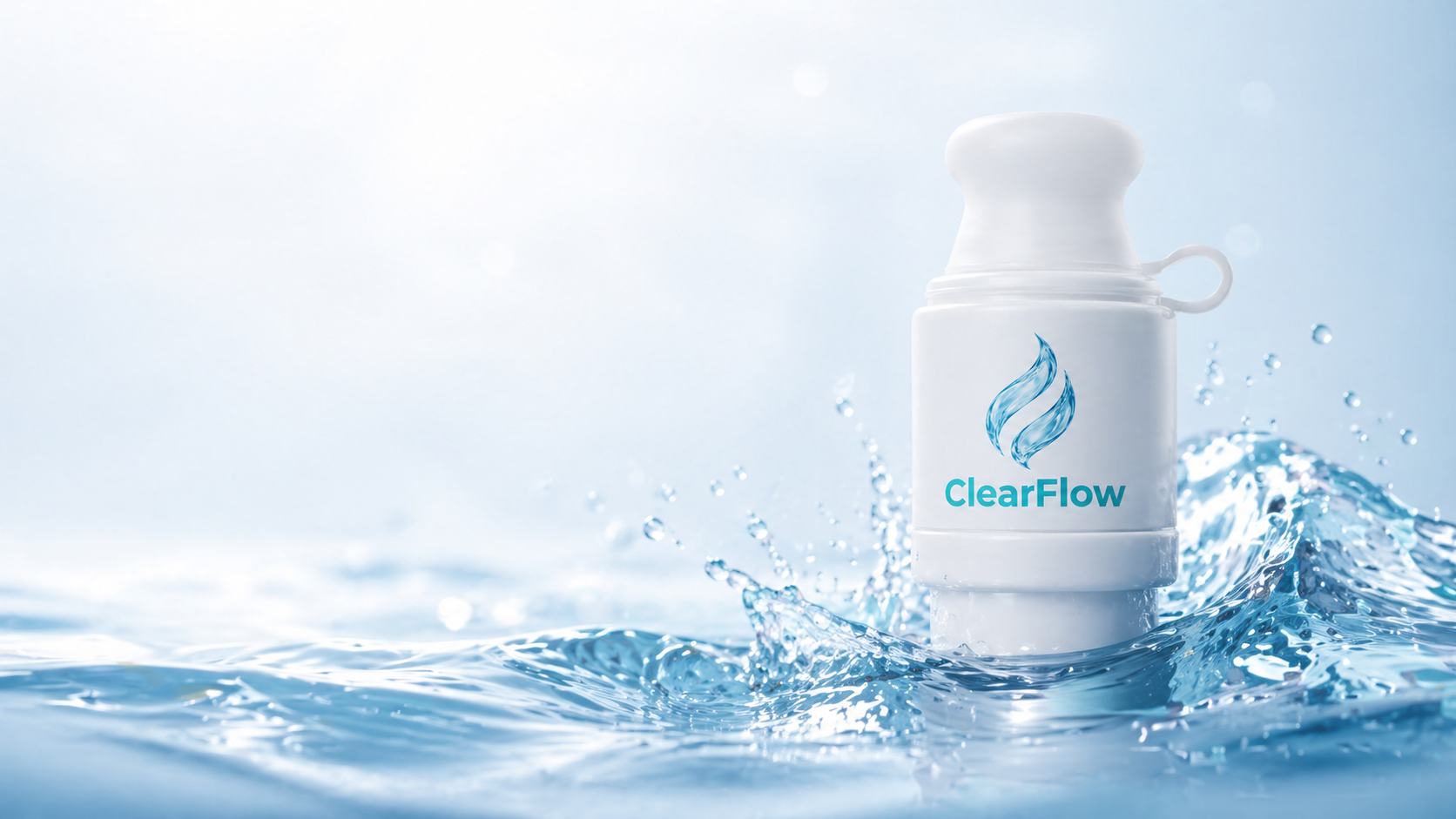
ClearFlow snaps onto any standard PET bottle and reduces microplastics through 2-micron pleated microfiltration.
- Fits Aquafina, Dasani, Poland Spring, Fiji, and any DIN 1881 bottle
- 99% microplastic reduction (particles 2 microns and larger) at sip pressure
- Reusable cap, no batteries, no power
A practical 5-step framework for drinking bottled water in 2025
- Choose by source, not by brand. Spring or artesian from a clearly stated source beats vague "purified" most of the time, unless local tap quality is itself excellent.
- Avoid heat-stressed bottles. Don't buy from outdoor pallet stacks. Don't drink water from a bottle that's been in a hot car for a week. Heat accelerates plastic shedding.
- Drink it fast. The longer water sits in PET, the more particles it picks up. Fresh-bought beats months-old.
- Filter at the point of drinking. A microplastic cap filter neutralizes the single biggest hidden problem with bottled water for pennies per bottle.
- Don't refill PET bottles for weeks on end. Single-use means single-use. Repeated washing and reuse increases shedding and bacterial load.
For travel-specific picks, see Travel Water Filter: A Country-by-Country Guide. For a broader buyer's guide that covers home and on-the-go options together, the best portable water filter 2026 roundup goes brand-by-brand. And if you want to see how Clear Flow specifically fits into all this, the Clear Flow product guide covers fit, flow rate, and care.
Bottom line
Bottled water in America is safe enough by FDA standards, comparable to good tap water on most chemistry, more expensive by orders of magnitude, and uniquely vulnerable on one issue the labels don't mention: microplastics. The mature consumer move in 2025 isn't to panic-quit bottled water or to defend it like a fan club. It's to know what you're buying, choose better when you can, and filter the one thing the brand can't.
FAQ
What is the safest bottled water brand in the USA?
There is no single "safest" brand by FDA standards — most major brands meet the same chemical thresholds. Brands with stable spring or artesian sources like Mountain Valley, Evian, and Fiji tend to score well in independent testing, but they cost more and still ship in plastic. For most Americans, safety differences between major bottled brands are smaller than the marketing suggests.
Is bottled water actually better than tap water?
For most Americans on a well-maintained municipal system, no. Bottled water is roughly equivalent in chemical safety to good tap water. It can be a better choice during boil-water advisories, in areas with lead service lines, or when traveling. It typically contains more microplastics than filtered tap water.
Which bottled water brands are just tap water?
Aquafina, Dasani, and Nestlé Pure Life all source from municipal water supplies and then treat the water through reverse osmosis or other purification. The label term that signals this is "purified water from a public water source." It is legal and clearly disclosed, but many shoppers don't realize it.
Does the FDA regulate microplastics in bottled water?
No. The FDA has no enforceable limit on microplastic content in bottled water as of 2025. California is the first state to require microplastic testing of drinking water, but federal standards do not exist. This is why a point-of-drinking microplastic filter is currently the only reliable consumer-side fix.
Why is bottled water so expensive at airports and convenience stores?
The pricing is driven by location, not the water itself. The same Aquafina that costs about 14 cents per bottle in a Costco 24-pack can cost four dollars at an airport kiosk. The water is identical; the markup reflects rent, captive demand, and convenience.
Can I just refill my plastic water bottle to avoid microplastics?
Refilling a PET single-use bottle for a few days is fine, but repeated long-term reuse increases plastic shedding and bacterial growth. PET wasn't engineered for daily refilling. A reusable stainless steel or glass bottle is better for long-term use, or a cap-style microplastic filter for the bottled water you do buy.
How long can bottled water sit before it's no longer safe?
Sealed bottled water doesn't really "go bad," but the FDA recommends a two-year shelf life for unflavored water. The bigger issue is plastic shedding: the longer water sits in a PET bottle, especially in heat or sunlight, the more microplastic particles it picks up. Fresh-bought beats long-stored.
Related reading
Pillar Guide
Microplastics in drinking water — the complete guide
Sources, health risks, regulation, and the full filtration landscape.
Technology
2-Micron filtration explained
The engineering threshold that separates real microplastic filtration from marketing.
Sources
- FDA — Bottled Water Everywhere: Keeping it Safe. U.S. Food and Drug Administration.
- Beverage Marketing Corporation (2024). U.S. Bottled Water Market Report.
- Qian, N. et al. (2024). Rapid single-particle chemical imaging of nanoplastics by SRS microscopy. PNAS.
- Mason, S.A. et al. (2018). Synthetic polymer contamination in bottled water. Frontiers in Chemistry.
- 21 CFR 165.110 — Bottled Water Standards of Identity.