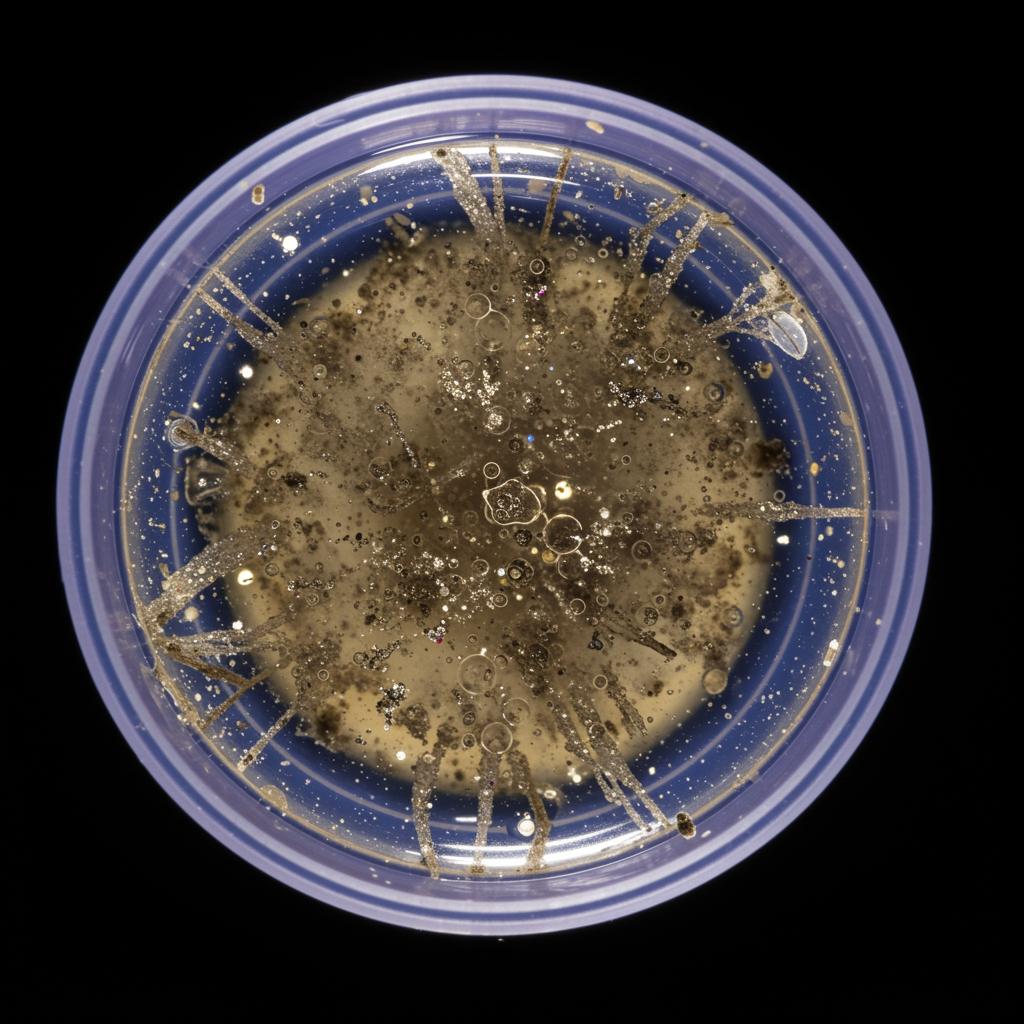
Kurz: Microplastics are plastic fragments under 5 mm that now show up in tap water, bottled water, food, air, and human tissue. Peer-reviewed studies link exposure mainly to packaging, textiles, tire wear, and bottled water. This hub summarizes what the science confirms — and what it does not.
Twenty years ago, the term microplastics barely existed outside marine biology journals. Today it sits on the front page of Wikipedia, in WHO briefings, and in thousands of peer-reviewed papers indexed on PubMed. The reason is simple: researchers keep finding plastic where they did not expect it — in placentas, testicles, brain tissue, lung samples, and the bottled water millions of Americans drink every day.
This page is the research hub for everything Clear Flow publishes on the science of microplastics. It is not a product page. It is the foundation we point readers to when they ask the only question that really matters: what does the evidence actually show? If you are looking for practical mitigation, see our Clear Flow product guide or the On-the-Go Microplastic Filters: How Cap-Style Bottle Filters Work pillar. If you want the science first, keep reading.
What microplastics actually are — and why size matters
Microplastics are plastic particles smaller than 5 millimeters in their longest dimension. Below 1 micrometer, researchers switch to a separate term: nanoplastics. The size cutoff is not cosmetic. It changes everything about how the particle behaves in the body, how it is detected in the lab, and which filtration technologies can capture it.
The 5 mm definition was formalized in 2009 by NOAA and is still the working benchmark in most peer-reviewed work. But the most biologically interesting particles are far smaller. Studies using Raman spectroscopy and stimulated Raman scattering microscopy now routinely report particles in the 100–1000 nanometer range. A 2024 paper in Proceedings of the National Academy of Sciences by Qian et al. found roughly 240,000 plastic particles per liter in popular bottled water — about 90% of them nanoplastics that previous methods had missed entirely.
| Size class | Range | Detection method | Biological concern |
|---|---|---|---|
| Macroplastics | > 5 mm | Visual | Wildlife entanglement |
| Mesoplastics | 5–25 mm | Visual / sieving | Marine ingestion |
| Microplastics | 1 µm – 5 mm | FTIR, Raman | Gut, lungs, immune system |
| Nanoplastics | < 1 µm | SRS, Py-GC/MS | Cellular uptake, blood-brain barrier |
The takeaway: most public discussion still pictures visible plastic flakes. The science has moved on. The particles that matter most are invisible to the naked eye — and the research community is still building the tools to count them properly. Our companion piece on Can You Actually See Microplastics in Your Water? unpacks why a glass of contaminated water still looks crystal clear.
Where microplastics come from: the four dominant sources
Source-apportionment studies — work that traces particles back to their origin polymer and product — have converged on four contributors that account for the majority of human exposure in developed economies.
- Synthetic textiles. A 2016 study by Napper and Thompson at Plymouth University found that a single 6 kg load of polyester laundry sheds between 137,000 and 728,000 microfibers. Wastewater plants capture some, but a meaningful fraction reaches rivers and the atmosphere.
- Tire and road wear. The OECD estimates tire abrasion is the single largest source of primary microplastics in the environment, contributing roughly 28% of the global ocean load. The particles are heavy, often carry road-runoff chemicals, and end up in stormwater.
- Plastic packaging — including bottled water. PET bottles, caps, and films degrade through mechanical stress, UV exposure, and heat. Studies on Microplastics in Bottled Water: What the Studies Actually Show consistently show particle counts ranging from 100 to several hundred thousand per liter depending on the method.
- Paints and coatings. Marine coatings, road markings, and architectural paints release particles that are chemically indistinguishable from other microplastics in field samples. A 2022 Environmental Action study estimated paint accounts for 1.9 million tons of ocean microplastic annually.
Secondary sources — the breakdown of larger plastic litter — fill in the rest. The relevant point for consumers is that source #3 is the only one most people interact with directly, repeatedly, and orally. That is why bottled water has become the central battleground in microplastic exposure science.
How microplastics enter the human body
Researchers have identified three confirmed exposure routes: ingestion, inhalation, and dermal contact. The first two dominate. Skin absorption appears limited to the smallest nanoplastics and is still poorly characterized.
Ingestion: the largest route by mass
A widely cited 2019 study in Environmental Science & Technology by Cox et al. estimated American adults ingest between 39,000 and 52,000 microplastic particles annually from food and water alone — a number that climbs to 90,000 if the person drinks bottled water exclusively. Subsequent work using nanoplastic-capable detection methods suggests the real figure is at least an order of magnitude higher.
Major dietary sources include seafood (especially bivalves, which filter-feed), table salt, beer, honey, sugar, and tap water in some municipalities. Our deep-dive on Microplastics in Drinking Water — The Complete Guide breaks down the per-liter counts measured in U.S. utilities.
Inhalation: smaller mass, deeper penetration
Indoor air contains 1.6 to 11 times more microplastic fibers than outdoor air, primarily from synthetic carpets, upholstery, and clothing. A 2022 study at Hull York Medical School identified microplastic particles in 11 of 13 lung tissue samples from living patients undergoing surgery. Particles reached the lower lung — a region previously assumed too deep for fiber penetration.
Dermal: the smallest contributor
Intact skin appears to block most particles above 100 nm. However, damaged skin, hair follicles, and sweat ducts may permit some uptake. The cosmetic industry's voluntary phase-out of polyethylene microbeads — codified in the 2015 U.S. Microbead-Free Waters Act — addressed the largest dermal exposure pathway.
Where the particles end up: human biodistribution
Until 2018, the question "do microplastics actually get inside the human body?" had no published answer. It does now. The list of tissues where peer-reviewed studies have detected plastic particles has grown every year since.
| Tissue | Year first reported | Lead institution | Particle types found |
|---|---|---|---|
| Stool | 2018 | Medical University of Vienna | PP, PET, PS |
| Placenta | 2020 | Hospital San Giovanni Calibita | Pigmented PP fragments |
| Blood | 2022 | Vrije Universiteit Amsterdam | PET, PS, PE, PMMA |
| Lung tissue | 2022 | Hull York Medical School | PP, PET, resin |
| Testicles | 2024 | University of New Mexico | 12 polymer types |
| Brain (olfactory bulb) | 2024 | University of São Paulo | PP fragments |
| Prostate tumors | 2025 | NYU Langone | PE, PS |
Detection in tissue does not by itself prove harm. It does answer a more basic question: the biological barriers we assumed would keep plastic out — gut wall, blood-brain barrier, placenta — are partially permeable to particles below a certain size. The Microplastics Found in Prostate Cancer Tumors: What the New NYU Study Means write-up covers the most recent and most discussed finding in clinical detail.
What the studies actually prove about health risk
This is where careful reading matters. The scientific record on microplastic toxicity is uneven. Animal and cell-culture studies show clear effects: oxidative stress, inflammation, endocrine disruption, gut microbiome changes. Human epidemiological evidence is much thinner because exposure is universal — there is no clean control group.
The strongest human study to date, published in The New England Journal of Medicine in March 2024 by Marfella et al., followed 257 patients who had carotid plaque removed. Patients with detectable polyethylene in the plaque had a 4.5× higher rate of heart attack, stroke, or death over 34 months compared with those without. The study is observational, not causal. But it is the first major prospective human dataset linking microplastic presence to a hard clinical endpoint.
Other documented or strongly hypothesized concerns include:
- Endocrine disruption from plasticizer additives (phthalates, bisphenols)
- Gut microbiome disturbance shown in mouse and zebrafish models
- Inflammatory response in lung tissue from inhaled fibers
- Vector effect — particles binding heavy metals and persistent organic pollutants and concentrating them in tissue
Our companion piece on Are Microplastics Dangerous? What the Latest Research Actually Says walks through the evidence rating tier by tier, separating what is proven from what is plausible. The What Microplastics Are Doing to the Human Body: A 2025 Evidence Review review covers the 2025 evidence base in full.
Bottled water: the most measured exposure source
Of all microplastic exposure pathways, bottled water has been studied most aggressively because it is testable, repeatable, and commercially relevant. Three landmark studies define the field.
- Mason et al., 2018 (State University of New York at Fredonia). Tested 259 bottles across 11 brands and 9 countries. Found an average of 325 particles per liter. 93% of samples contained microplastics.
- Schymanski et al., 2018 (German Federal Institute). Found higher particle counts in single-use PET bottles than in glass, with the highest counts in returnable PET bottles — implicating cap and bottle wear, not just the original water source.
- Qian et al., 2024 (Columbia and Rutgers). Using stimulated Raman scattering, detected ~240,000 particles per liter in popular U.S. bottled water brands, ~90% nanoplastics. This was a roughly 100× increase over previous estimates because the method finally captured sub-micrometer particles.
The pattern is consistent across studies: every commercial bottled water tested contains microplastic particles, and the number depends as much on the method as on the brand. We track the brand-by-brand data in Which Bottled Water Brands Have the Most Microplastics?.
Why detection numbers vary so much between studies
If you have read three articles on microplastic counts in water and seen three completely different numbers, the explanation is methodological. The number you get depends on five choices the researcher makes before any water enters the lab.
- Lower size limit. A study that counts down to 1 µm will report 10–100× fewer particles than one that counts down to 100 nm.
- Detection technology. FTIR, Raman, SRS, and pyrolysis-GC/MS each have different sensitivity floors and different polymer libraries.
- Sample preparation. Filtration, digestion of organic matter, and staining can introduce or destroy particles.
- Polymer set. Most studies count 5–10 common polymers. Particles outside that set are excluded.
- Contamination control. Background plastic from lab air, gloves, and tools can dwarf the actual sample if not rigorously excluded.
This is why thoughtful coverage cites the method alongside the number. "240,000 particles per liter" is not contradicted by "325 particles per liter" — they answer different questions about different size ranges.
What current filtration technologies actually remove
Removal effectiveness depends on the smallest particle a filter can physically stop, the contact time between water and filter media, and whether the system targets adsorption (chemicals) or size exclusion (particles).
| Technology | Smallest particle removed | Microplastic effectiveness | Format |
|---|---|---|---|
| Sediment filter (5 µm) | ~5 µm | Removes large MPs only | Whole-house, pitcher |
| Activated carbon block | ~0.5 µm | Removes most MPs > 1 µm | Faucet, fridge |
| Ultrafiltration (UF) | ~0.01 µm | Removes MPs and most nanoplastics | Under-sink, cap-style |
| Reverse osmosis | ~0.0001 µm | Removes essentially all | Under-sink, countertop |
The takeaway for everyday consumers: anything finer than ~0.2 microns will catch the bulk of microplastic particle mass, even if some nanoplastics slip through. We unpack the trade-offs in Activated Carbon vs. Ultrafiltration: Which Removes More? and the 0.2-Micron Filtration Explained: What It Removes and Why It Matters explainer. For people who drink mainly bottled water, the relevant question is portable filtration — covered in Portable Water Filter — The Complete Buyer's Guide and our cap-filter primer at Bottle Cap Water Filters: How They Work.
Regulatory status in the United States
As of 2026, no U.S. federal regulation sets an enforceable limit on microplastics in drinking water. The EPA classifies microplastics as a "contaminant of emerging concern" and includes them on the Contaminant Candidate List 5, which is a research priority list, not a regulatory standard. The FDA, which regulates bottled water, has not issued a microplastic guideline.
California became the first jurisdiction in the world to require utility-level microplastic monitoring under SB 1422, signed in 2018, with the first standardized test methods finalized in 2022. Results from the four-year monitoring program are still being aggregated. The Microplastics and Drinking Water: Where the FDA and EPA Stand explainer tracks the current regulatory state in detail.
Internationally, the WHO's 2019 report concluded that current evidence does not justify alarm but also flagged "urgent need" for better data — particularly on nanoplastics, which the report could not assess. The European Commission has moved further, banning intentionally added microplastics in cosmetics, detergents, and fertilizers under REACH as of 2023.
What "reasonable precaution" looks like under uncertainty
The honest answer about microplastic health effects in 2026 is: the human exposure is real and rising, the biological plausibility of harm is high, the cell and animal evidence is consistent, and the human epidemiology is still maturing. That combination — strong mechanistic evidence, weaker direct human evidence — is the same pattern that historically preceded confirmed harm from lead, PFAS, and tobacco smoke.
Public-health researchers like Tracey Woodruff at UCSF have argued for a precautionary stance: reduce exposure where it is cheap to do so, even before causation is fully established. For microplastic exposure specifically, the cheap-to-reduce sources cluster around three behaviors:
- Switching from bottled to filtered tap water at home
- Filtering bottled water on the go when tap is unavailable
- Reducing synthetic textile shedding through laundry choices and ventilation
Our Reducing Plastic Exposure in Everyday Life pillar covers the full behavioral playbook. If you commute, travel, or train in environments where bottled water is the only option, the Water Filter for the Gym, Office & Daily Commute and Travel Water Filter: A Country-by-Country Guide guides are the practical follow-ups. For the product side, see our 2026 portable filter picks.
Filter the most-studied exposure source.
Bottled water is the single microplastic exposure pathway you can mitigate today without changing your routine. ClearFlow brings 0.2-micron hollow-fiber ultrafiltration into a cap that fits any standard PET bottle.
- Captures microplastics across the size range studied in drinking-water research
- Medical-grade 0.2-micron membrane — same standard used in sterile filtration
- Sip-pressure operation — no pump, no power, no waiting
Open questions the science has not answered yet
A research hub that does not flag its own gaps is not credible. Five questions remain genuinely open in the peer-reviewed literature, and the answers will shape policy and consumer behavior over the next decade.
- What is the lifetime body burden? No study has measured cumulative tissue load over decades.
- Do nanoplastics cross the blood-brain barrier in adults? Animal data says yes; human data is preliminary.
- Is the additive chemistry the real driver of harm? Many effects attributed to particles may stem from leached plasticizers.
- Are some polymers worse than others? PVC and polystyrene look more concerning in cell culture; field studies cannot yet confirm.
- What dose, if any, is biologically meaningful? Threshold-of-effect data is essentially nonexistent for chronic low-dose exposure.
Researchers from Columbia, ETH Zurich, the University of Vienna, and the University of California system are running multi-year studies to close these gaps. Expect the answers — and the consumer recommendations that follow — to evolve through 2030.
Bottom line
Microplastic research has moved from "does this matter?" to "how much, where, and what do we do about it?" in less than a decade. The particles are in our water, food, air, and tissue. The evidence base is strongest for exposure quantification, growing for biodistribution, and still maturing for direct human health outcomes. For the average reader, the practical implication is narrow: the cheapest, most studied exposure source is bottled water, and it is the easiest to mitigate without changing daily routines. For the deeper science, the studies cited above are the entry points. For our practical playbook, start with the Clear Flow product guide or browse the research blog.
FAQ
How many microplastics does the average American consume per year?
A 2019 Environmental Science & Technology study estimated 39,000 to 52,000 particles annually from food and water alone, climbing to roughly 90,000 for people who drink only bottled water. Newer detection methods that capture nanoplastics suggest the real figure is at least an order of magnitude higher.
Have microplastics been found inside the human body?
Yes. Peer-reviewed studies have detected plastic particles in human stool, blood, lung tissue, placenta, testicles, brain tissue, and prostate tumors. Detection alone does not prove harm, but it confirms that biological barriers like the gut wall and blood-brain barrier are partially permeable to small particles.
What is the difference between microplastics and nanoplastics?
Microplastics are plastic particles between 1 micrometer and 5 millimeters. Nanoplastics are below 1 micrometer. Nanoplastics are smaller, more likely to penetrate cells and tissues, and require advanced detection methods like stimulated Raman scattering microscopy.
Why do microplastic counts in bottled water vary so much between studies?
Reported numbers depend heavily on the lower size limit, detection technology, polymer library, and contamination controls. A 2018 study counting down to 6.5 micrometers found 325 particles per liter, while a 2024 study counting nanoplastics in similar water found around 240,000 per liter.
Are microplastics regulated in U.S. drinking water?
No federal enforceable limit exists as of 2026. The EPA classifies microplastics as a contaminant of emerging concern on Contaminant Candidate List 5. California requires utility-level monitoring under SB 1422 but has not yet set a numerical limit.
What filter size removes microplastics from drinking water?
A 0.2-micron filter captures most microplastic particles by mass. Ultrafiltration around 0.01 micron and reverse osmosis around 0.0001 micron also remove most nanoplastics. Standard 5-micron sediment filters only catch the largest particles.
Related reading
Sources
- Marfella, R. et al. (2024). Microplastics and Nanoplastics in Atheromas and Cardiovascular Events. New England Journal of Medicine.
- Qian, N. et al. (2024). Rapid single-particle chemical imaging of nanoplastics by SRS microscopy. PNAS.
- Cox, K. D. et al. (2019). Human Consumption of Microplastics. Environmental Science & Technology 53(12), 7068–7074.
- Mason, S. A., Welch, V. G., Neratko, J. (2018). Synthetic Polymer Contamination in Bottled Water. Frontiers in Chemistry.
- WHO (2019). Microplastics in drinking-water.
- U.S. EPA — Contaminant Candidate List 5 (CCL 5).